
My favourite drought-tolerant plants for UK Gardens
My favourite drought-tolerant plants for UK Gardens
Hotter, drier periods are becoming an increasingly important consideration when choosing plants for UK gardens. That doesn’t mean planting has to become sparse or limited to an obviously Meditertranean palette.
Many of the plants I already like to use for their form, texture, movement and long flowering season are also surprisingly resilient during dry weather once established.
Some are genuinely very drought-tolerant; others simply cope well with extended dry spells. Soil type, aspect and establishment all make a difference, of course, but these are some of my favourite drought tolerant plants for UK gardens, particularly where I want planting to remain interesting, generous and contemporary through summer.
Drought tolerant plants for contemporary gardens
These are some of my favourite drought tolerant plants for contemporary gardens – plants that combine resilience with the form, texture, movement and seasonal interest I look for in a planting scheme.
Salvia nemorosa ‘Caradonna’
One of the most useful salvias for creating strong vertical accents through a border.
‘Caradonna’ has particularly dark stems carrying violet-blue flowers, giving it considerably more definition than its relatively delicate scale might suggest. It works beautifully repeated through grasses and softer perennials, and cutting it back after its first flowering can encourage another flush.
Why I like it: strong vertical form, rich colour and a long flowering season – it is also very commonly grown and easy to get hold of – a garden designers’ favourite!
Salvia yangii ‘Blue Spire’
Formerly known as Perovskia, this has a completely different character to Salvia nemorosa.
The silvery foliage and fine stems create a hazy cloud of blue in late summer. I particularly like the way it can soften stronger planting and hard landscaping without becoming visually heavy.
It is at its best in full sun and free-draining soil.
Why I like it: softness, silver foliage and an almost translucent quality.
Achillea
Achilleas have been particularly good this year.
Their flat flower heads bring an important change of shape to a planting scheme, contrasting beautifully with vertical salvias and grasses. There is also a very useful range of colours, from creams and soft yellows to ochres, terracottas and deeper tones.
Even as the flowers fade, the structure remains attractive.
Why I like them: long-lasting structure, subtle colour and excellent contrast of form. Will look good even with very little water.
Echinacea
Coneflowers have an easy generosity that works particularly well from midsummer onwards.
They produce large, daisy-like flowers over a long period and, once established, can tolerate spells of dry weather reasonably well. I wouldn’t describe Echinacea as a plant you can simply put in and forget about, but in the right conditions it is a useful and resilient summer perennial.
The seed heads are also worth retaining later in the year.
Why I like them: long flowering, strong flower form and excellent late-summer presence.
Nepeta ‘Walker’s Low’
Nepeta is one of my favourite plants for softening the edges of paths, terraces and steps.
The aromatic grey-green foliage forms relaxed mounds covered in lavender-blue flowers for a long period. It is particularly effective when repeated generously rather than dotted individually through a border.
Why I like it: softness, scent and the ability to create a calm rhythm through planting. It can also be given the ‘Chelsea Chop’ or pruned hard back throughout the summer to produce neat mounds of fresh foliage and new flowers.
Penstemon
Penstemons bring a slightly different quality to dry summer planting.
Their flower spikes are less rigid than Salvia and they work particularly well where I want a scheme to feel abundant rather than overtly architectural. Deadheading encourages them to keep producing flowers, often over a remarkably long period.
Why I like them: repeat flowering (if deadheaded), graceful form and a wide choice of colours.
Lavender
Lavender remains one of the most reliable choices for a sunny, dry position, provided the drainage is good.
I tend to favour Lavandula angustifolia and Lavandula × intermedia. Used with restraint, lavender can work very well in contemporary gardens, particularly as repeated edging, low structure or a scented element close to a path or seating area.
Why I like it: scent, evergreen structure and excellent drought tolerance once established.
Eryngium
Eryngiums have an almost sculptural quality.
Their metallic blue-grey flowers and spiky forms provide a useful point of contrast amongst softer planting. I generally prefer them used selectively, where their distinctive shape can punctuate a scheme rather than dominate it.
Their dried flower heads can remain attractive long after flowering.
Why I like them: architectural detail, unusual colour and lasting structure.
Hylotelephium (Sedum)
Succulent foliage makes this group naturally well equipped for dry conditions.
The broader-leaved Hylotelephium types develop substantial flower heads from late summer into autumn, while lower-growing Sedums can be very useful in gravel planting, dry edges, around tree trunks and other difficult dry areas.
Their later flowering season is especially valuable as many earlier perennials begin to fade.
Why I like them: strong foliage, late-season interest and excellent resilience.
Phlomis fruticosa
Jerusalem sage is an excellent plant for a warm, sunny position.
Its grey-green foliage has real substance and the yellow hooded flowers are held in distinctive tiers around upright stems. The dried flower heads retain that structure afterwards, giving the plant interest beyond its main flowering period.
It has a stronger architectural presence than many drought-tolerant perennials.
Why I like it: robust structure, tactile foliage and distinctive flower form.
Stachys byzantina
Lamb’s ears is grown as much for its foliage as its flowers.
The soft, felted silver leaves create an excellent textural contrast with darker greens and finer grasses. Its low-growing habit also makes it useful towards the front of borders and alongside paths.
Why I like it: tactile foliage that is great for sensory gardens, silver colour and excellent ground-level texture.
Armeria maritima
Sea thrift is perhaps not one of the first plants people think of for a contemporary dry garden, but I find it extremely useful.
Its dense, deep-green cushions can remain looking remarkably fresh when surrounding planting is beginning to suffer in dry weather. Above the foliage, small pink or white flower heads appear on fine stems.
It is especially effective tucked along path edges, amongst gravel or in other exposed positions.
Why I like it: that deep evergreen colour, compact form and resilience when conditions become dry.
Liatris
Liatris produces wonderfully upright flower spikes that flower from the top down, giving it a distinctive character amongst more familiar summer perennials.
The strong purple-pink verticals work well amongst looser planting and grasses. I also think it can be particularly effective when trying to introduce a slightly more exotic or tropical feeling without relying on obviously tender planting.
Why I like it: strong vertical accents and an unexpectedly exotic quality.
Hemerocallis
Daylilies are another plant I think can be overlooked when discussing planting for drier summers.
There is an enormous range of varieties and, once established, many cope surprisingly well with periods of reduced rainfall, particularly in soils that retain some underlying moisture.
They also tend to flower before conditions reach their driest later in the summer, which can be useful when planning a succession of interest.
Why I like them: reliable early-summer flowering, bold foliage and resilience.
Digitalis parviflora ‘Milk Chocolate’
Not every useful plant for a dry garden is found on the usual drought-tolerant plant lists.
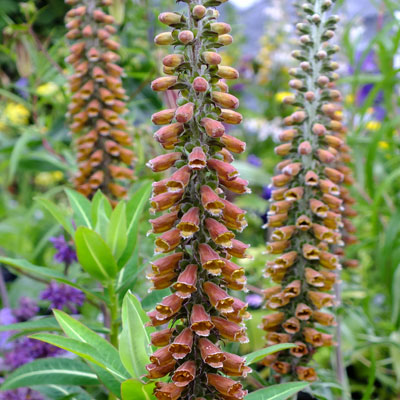
Digitalis parviflora ‘Milk Chocolate’ is a perennial foxglove with slender spikes of small, dusky bronze-brown flowers. It gives the vertical quality of a foxglove but in a much more restrained and unusual colour palette.
I particularly like it woven amongst grasses and naturalistic perennial planting.
Why I like it: unusual colour, fine vertical form and something slightly unexpected.
Stipa gigantea
Few grasses have quite the presence of Stipa gigantea.
Its low mound of foliage sends up tall stems carrying golden oat-like flower heads which catch both sunlight and movement. Despite its height, it never feels heavy because you can see straight through it.
That transparency makes it enormously useful in contemporary planting.
Why I like it: height without visual weight, movement and its interaction with light.
Oenothera lindheimeri
Still better known to many people as Gaura, this is another plant I use for movement rather than mass.
Its fine stems carry small white or golden flowers that seem to float above the rest of the planting. In a breeze, the effect can be particularly beautiful.
It works best for me threaded amongst other plants rather than arranged in solid blocks.
Why I like it: movement, delicacy and a long season of flower. Really no need to worry about watering
Euphorbia characias subsp. wulfenii
This Euphorbia is particularly valuable earlier in the season.
Its substantial blue-green foliage forms architectural mounds, followed by large acid-green flower heads in spring. That colour can look superb against deeper greens and emerging grasses.
It brings structure without requiring the formality of clipped planting.
Why I like it: strong foliage, early-season interest and its distinctive green flowers.
Artemisia ‘Powis Castle’
Good foliage becomes even more important during dry weather.
Artemisia ‘Powis Castle’ has finely divided silver-grey leaves that contrast beautifully with richer greens, purples and blues. It is also particularly effective alongside pale stone, gravel and weathered timber.
The key is not to overuse silver foliage. A little can transform the palette.
Why I like it: fine texture, silver colour and the way it complements other plants and materials.
Phillyrea angustifolia
Finally, drought-tolerant planting doesn’t need to consist entirely of perennials and grasses.
Phillyrea angustifolia is an understated evergreen shrub with small, dark leaves and a naturally dense habit. It can be clipped into simple forms or allowed to grow more naturally, making it particularly useful for introducing permanent structure amongst looser planting.
Why I like it: quiet evergreen structure and a refined alternative to more familiar clipped shrubs.
Choosing drought-tolerant plants for a UK garden
Drought tolerance is always relative. Soil, drainage, aspect and the maturity of a plant all make a significant difference.
Even plants that are very tolerant of dry conditions once established will need watering during their first season, and often longer during extended periods without rain.
For me, the aim isn’t to create a garden that simply survives drought. It is to choose plants that suit the conditions while still giving the garden all the things I want from a planting scheme: structure, movement, texture, scent, seasonal change and atmosphere.
And, increasingly, resilience needs to be part of that conversation too.